
ISO 14001:2026 : What Has Actually Changed
ISO 14001:2026 : What Has Actually Changed (And Why It Matters Now)
After more than a decade, the revised ISO 14001:2026 has officially been published, replacing the 2015 version. Naturally, the first question most organizations are asking is simple: what’s really changed?
The honest answer is – less than you might expect on the surface, but more than you might realize in practice.
This revision has taken more than ten years to materialize but that doesn’t make it a disruptive rewrite of Environmental Management Systems (EMS). Instead, it’s a deliberate refinement. The structure remains familiar, the clauses are still aligned with Annex SL, and the overall framework hasn’t been touched dramatically. But the intent behind the requirements has clearly shifted. ISO is no longer satisfied with systems that exist on paper, it now expects systems that can work on outcomes.
That distinction is exactly what defines the 2026 revision.
A Shift from Intent to Performance
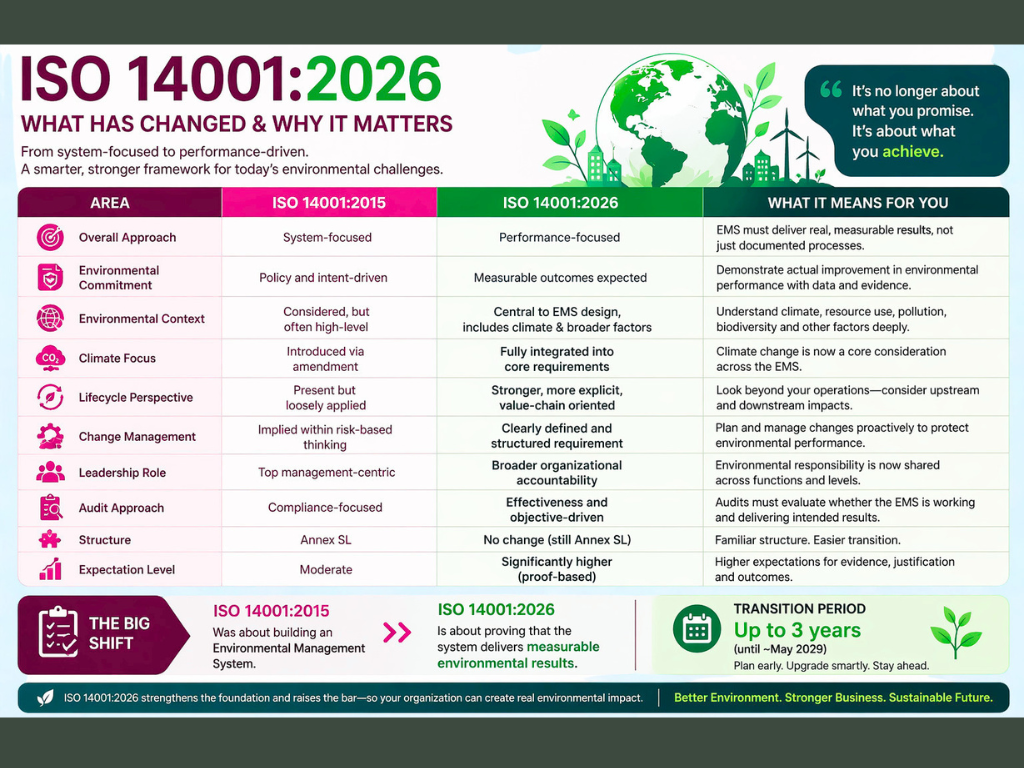
One of the most noticeable changes in ISO 14001:2026 is its stronger emphasis on measurable environmental performance. Earlier, organizations could show their compliance through policies, documented procedures, and commitments. While those elements still exist, they no longer carry the same weight on their own.
Now, the expectation is more direct. If your organization claims to manage environmental impact effectively, it should be able to show clear, data-backed results. Whether it’s reduction in emissions, improved resource efficiency, or better waste management outcomes, the focus has moved toward what is actually being achieved.
In simple terms, just having a well-documented EMS is no longer enough, the system needs to prove that it works.
Environmental Context – No Longer A Background Information
Another important shift lies in how organizations are expected to understand their environmental context. Theoretically, this was always part of the standard, but in the 2026 version, it has become far more central.
Climate change, resource availability, pollution levels, and even biodiversity are now expected to be actively considered when defining and managing the EMS. These are no longer peripheral considerations or “good-to-have” inputs. They directly influence how risks and opportunities are identified, how objectives are set, and how controls are designed.
What this means in practice is that organizations need to move beyond generic environmental assessments and develop a context that is specific, relevant, and continuously evaluated.
Lifecycle Thinking – Strengthened
Lifecycle perspective isn’t new to ISO 14001, but it has definitely been reinforced. The 2026 revision makes it clearer that environmental responsibility doesn’t stop at the organization’s boundary.
There is now stronger emphasis on understanding impacts across the entire value chain, i.e., from procurement and supplier activities to product use and final disposal. This doesn’t necessarily mean full control over every stage, but it does require awareness, influence, and consideration in decision-making.
For many organizations, this is where the real challenge will lie. It requires looking outward, engaging with suppliers more actively, and thinking beyond internal operations.
Managing Change – Now a Defined Requirement
One of the more practical additions in ISO 14001:2026 is the clearer focus on planning and managing change. While change was always implied within risk-based thinking, it is now addressed more explicitly.
Organizations are expected to anticipate changes, whether operational, regulatory, or strategic, and assess how these changes might affect environmental performance. The idea is to avoid reactive adjustments and instead, intuitively, build a system where change is planned, evaluated, and controlled.
This is exactly how modern organizations operate, where change is constant rather than occasional.
Leadership Expectations – Expanded
Leadership requirements have also evolved, though not dramatically in structure. What has changed is the depth of accountability.
Environmental management is no longer seen as something owned by a single department or function. The expectation now is that responsibility is more widely distributed across the organization, with stronger involvement from different levels of leadership.
This doesn’t necessarily mean new roles or titles, but it does mean that EMS can no longer operate in isolation. It needs to be integrated into broader business decision-making.
Audits – More Purpose Driven
Internal audits in ISO 14001:2026 are expected to move beyond routine compliance checks. There is now greater emphasis on defining clear audit objectives and linking them directly to system effectiveness.
This changes the way audits are approached. Instead of simply verifying whether procedures are followed, auditors are expected to evaluate whether the system is actually delivering intended results.
Though a subtle shift, it significantly raises the quality and purpose of internal audits.
No Major Structural Changes But Higher Expectations
It’s worth reiterating that the overall framework of ISO 14001 hasn’t changed much. The familiar clause structure remains intact, and organizations already certified to ISO 14001:2015 will find the transition quite manageable.
However, the level of expectation has clearly increased. The standard now demands stronger justification, clearer evidence, and more meaningful outcomes. In many ways, it reflects how environmental management has evolved over the past decade – from a mere compliance exercise to a core business concern.
What This Means Going Forward
For organizations already certified under ISO 14001:2015, this revision should be seen as an upgrade rather than a complete reset. Most systems will not need to be rebuilt, but they will need to be strengthened, especially in areas like performance measurement, lifecycle thinking, and environmental context.
There is also a transition period of up to three years, which provides enough time to make these adjustments in a structured way.
For organizations that are new to ISO 14001, the 2026 version offers a more mature and realistic framework- one that fits better with current environmental and sustainability expectations.
In Short
ISO 14001:2015 helped organizations put environmental systems in place.
ISO 14001:2026 expects those systems to deliver measurable results.
Not a dramatic shift in wording but a significant shift in expectation.
And for most organizations, that’s where the real work begins.
Good luck with your environmental management journey in the results-oriented era!
(Ref : International Standards Organization)
Connect with us here to know more.