
ISO 27001 vs SOC2
A growing technology company was close to signing its biggest international client when the security team received a familiar question: “Are you ISO 27001 certified, or do you have a SOC 2 report?” The founders knew both were important, but they were unsure which one the business actually needed. Like many organisations, they soon discovered that ISO 27001 and SOC 2 may address similar security concerns, yet they serve different purposes, markets and customer expectations. We’ll help you understand.
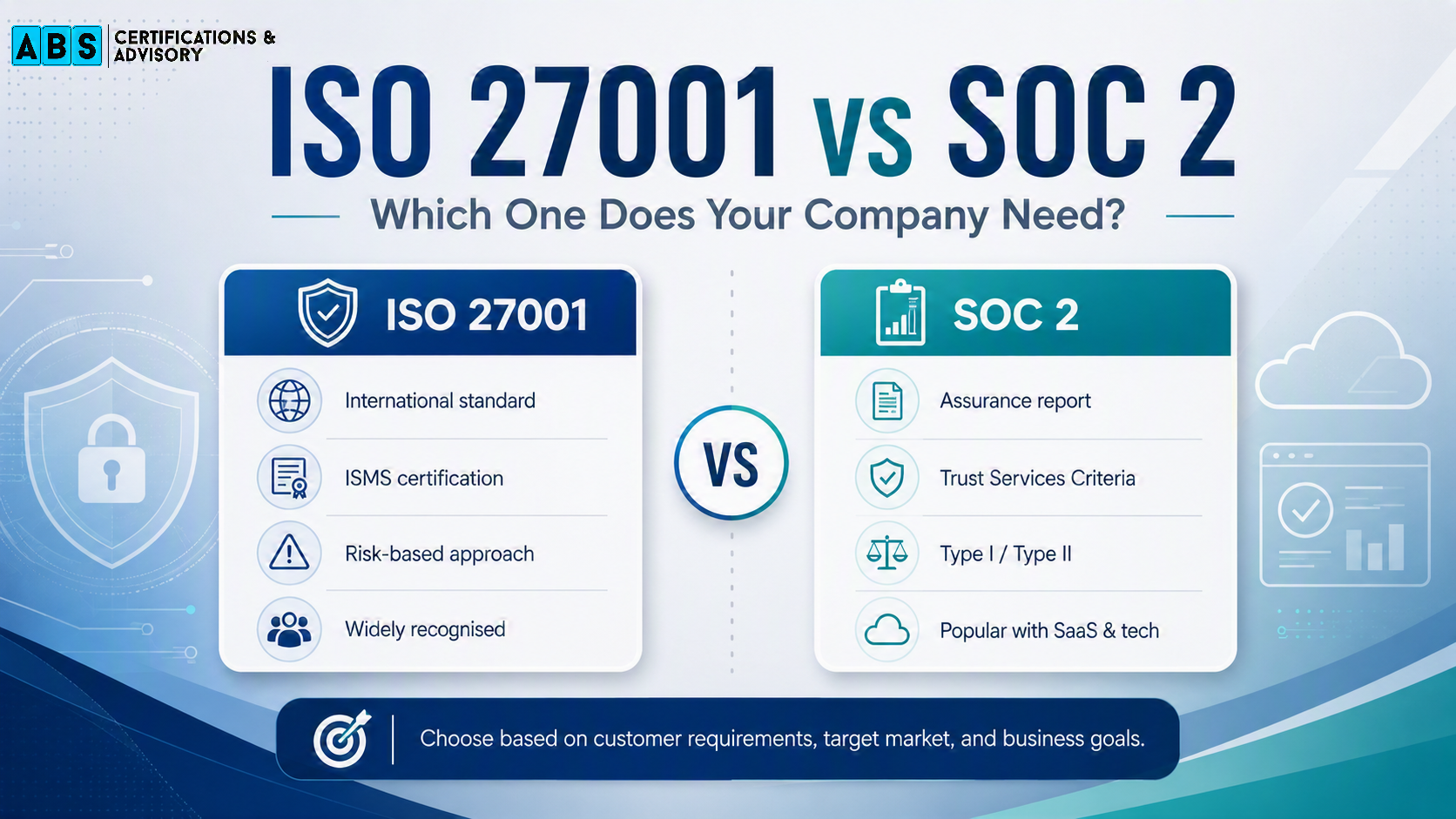
ISO 27001 vs SOC 2: Which One Does Your Company Need?
As customers become more concerned about cybersecurity, privacy and third-party risks, organisations are increasingly expected to confirm that their information security controls are reliable. Two of the most widely requested frameworks are ISO 27001 and SOC 2. Although both strengthen security and customer confidence, they are not the same.
The right choice depends on your customers, target markets, contractual requirements and business objectives. Some organisations need ISO 27001, some need SOC 2, and many technology companies benefit from implementing both.
What Is ISO 27001?
ISO/IEC 27001 is an international standard for establishing, implementing, maintaining and continually improving an Information Security Management System, commonly known as an ISMS. It takes a risk-based approach to protecting information and can be applied to organisations of any size or industry.
ISO 27001 requires an organisation to define its ISMS scope, assess information security risks, select appropriate controls, assign responsibilities, conduct internal audits, complete management reviews and continually improve the system.
Certification is awarded following an independent audit by a certification body. A successful organisation receives an ISO 27001 certificate proving that its information security management system meets the standard’s requirements.
What Is SOC 2?
SOC 2 is an assurance reporting framework developed by the American Institute of Certified Public Accountants. It evaluates controls at a service organisation against five Trust Services Criteria:
- Security
- Availability
- Processing Integrity
- Confidentiality
- Privacy
Security is included in every SOC 2 engagement, while the other categories are selected according to the services provided, customer commitments and associated risks.
A SOC 2 engagement produces a detailed assurance report rather than a conventional certificate. The report describes the organisation’s system, its controls, the auditor’s testing and the test results.
SOC 2 Type I assesses whether controls are suitably designed as of a specified date. SOC 2 Type II assesses both control design and operating effectiveness over a defined review period, making it more commonly requested by enterprise customers.
Key Differences Between ISO 27001 and SOC 2
The most visible difference is the final deliverable. ISO 27001 results in a certification that can be shared publicly, while SOC 2 produces a detailed assurance report that is normally shared with customers and authorised parties under controlled conditions.
ISO 27001 focuses on the organisation’s overall information security management system. It emphasises governance, risk management, leadership, internal audit and continual improvement.
SOC 2 focuses more directly on controls supporting a defined service or system. It gives customers detailed information about how the controls were tested and whether they operated effectively.
ISO 27001 has broad international recognition across industries and countries. SOC 2 is particularly common among SaaS providers, cloud companies, data processors and technology vendors serving customers in the United States.
When Should You Choose ISO 27001?
ISO 27001 may be the better starting point when:
- Customers or tenders specifically require an ISO 27001 certificate.
- You operate internationally and need widely recognised certification.
- You want a structured, organisation-wide information security programme.
- You work with government departments, large corporations or regulated sectors.
- You want to integrate information security with ISO 9001, ISO 22301, ISO 20000-1 or ISO 27701.
- You need a certificate for proposals, tenders and marketing materials.
ISO 27001 is especially useful for organisations seeking a long-term information security management framework rather than merely meeting one customer requirement.
When Should You Choose SOC 2?
SOC 2 may be more suitable when:
- Enterprise customers request a SOC 2 report during vendor due diligence.
- You provide SaaS, cloud, managed IT, hosting, fintech, BPO or other technology-enabled services.
- Customers want detailed assurance about how your controls operate.
- You are entering or expanding within the US market.
- Contract negotiations require evidence of control effectiveness over time.
- Customers specifically request a SOC 2 Type II report.
For growing technology companies, the absence of a SOC 2 report can delay procurement, security reviews and contract approvals.
Do You Need Both ISO 27001 and SOC 2?
Many organisations benefit from achieving both. ISO 27001 can provide the governance, risk-management and continual-improvement foundation, while SOC 2 provides detailed assurance over controls supporting a particular service.
There is substantial overlap in areas such as access control, risk assessment, incident management, change management, vendor management, security awareness, business continuity, vulnerability management and security monitoring. The AICPA also provides a formal mapping between the Trust Services Criteria and ISO 27001 requirements.
A well-designed integrated control framework can therefore reduce duplication and allow the same policies, records and technical evidence to support both engagements.
However, one does not automatically replace the other. ISO 27001 certification does not mean that an organisation has completed a SOC 2 examination, and a SOC 2 report does not constitute ISO 27001 certification.
How to Make the Right Decision
Begin by reviewing customer contracts, tender requirements, target markets and common sales objections. Involve your sales, compliance, information security and legal teams to identify which requirement appears most frequently.
Choose ISO 27001 when you need internationally recognised certification and a comprehensive ISMS. Choose SOC 2 when customers require detailed assurance regarding the controls supporting your services.
Consider implementing both when you serve international customers with overlapping regional, regulatory and contractual requirements.
Need Help With ISO 27001 or SOC 2?
ABS Certifications & Advisory supports organisations with readiness assessments, documentation, control implementation, evidence reviews, internal audits and audit preparation for ISO 27001 and SOC 2 engagements.
Contact us to identify the most appropriate information security and compliance roadmap for your organisation.
Ref : International Organization for Standardization ; AICPA & CIMA