
SOC 2 Type I vs Type II: Timeline, Evidence and Cost Factor
SOC 2 Type I vs Type II: Timeline, Evidence and Cost Factors Explained
You have probably reached this page because a customer, investor or potential business partner has asked a familiar question:
“Do you have a SOC 2 report?”
At first, the answer may seem simple. You start researching SOC 2 and quickly discover that there are two main options: SOC 2 Type I and SOC 2 Type II.
Both reports assess your organisation’s controls, but they do so in different ways. Choosing the right one depends on your business stage, customer expectations, available evidence and how quickly you need the report.
Let us break down the difference keeping it layman friendly.
What Is a SOC 2 Report?
SOC 2 is an assurance framework commonly used by SaaS companies, cloud service providers, IT companies, managed service providers, data processors and other organisations that handle customer information.
A SOC 2 engagement evaluates controls against the applicable Trust Services Criteria:
- Security
- Availability
- Processing Integrity
- Confidentiality
- Privacy
Security is normally included in every SOC 2 engagement. The other categories are selected based on your services, customer commitments and risks.
One important point is that SOC 2 does not usually result in a certificate. It produces a detailed assurance report containing information about your systems, controls, auditor testing and conclusions.
What Is SOC 2 Type I?
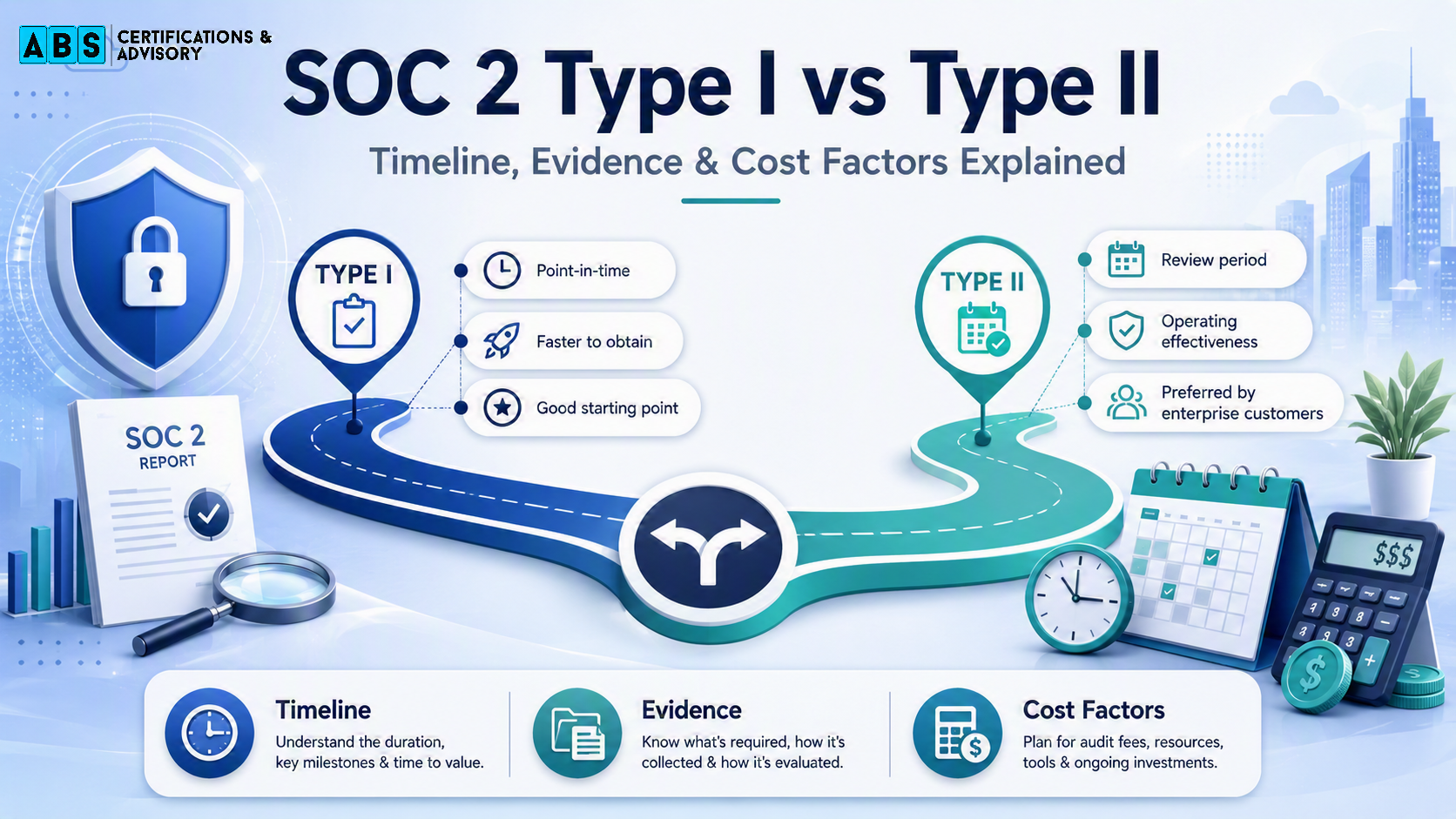
A SOC 2 Type I report examines whether your controls are suitably designed and implemented as of a specific date.
Think of it as taking a photograph of your compliance programme.
The auditor checks whether the controls existed on the selected date and whether they were designed appropriately to meet the relevant criteria.
For example, the auditor may review whether your company has:
- An information security policy
- Access-control procedures
- Risk-assessment records
- Incident-response processes
- Employee background checks
- Security-awareness training
- Vendor-management controls
- Backup procedures
- Change-management processes
A Type I report can be useful for start-ups and growing businesses that have recently implemented their controls and need an independent report relatively quickly.
However, it does not provide assurance that the controls operated consistently over several months.
What Is SOC 2 Type II?
A SOC 2 Type II report goes a step further.
It evaluates whether the controls were suitably designed and whether they operated effectively throughout a defined review period.
Instead of taking one photograph, the auditor looks at what happened over time.
The observation period may be three, six, nine or twelve months, depending on customer requirements, business needs and the organisation’s readiness. Many enterprise customers prefer a report covering at least six months.
During the audit, the auditor may test samples of:
- Employee onboarding and offboarding records
- Access approvals and access reviews
- Security incidents
- Software changes
- Vulnerability scans
- Penetration-testing reports
- Backup restoration tests
- Vendor assessments
- Security-training records
- Management reviews
- Business-continuity exercises
Because Type II tests operating effectiveness, it is generally considered more valuable during vendor assessments and enterprise procurement reviews.
SOC 2 Type I vs Type II: The Main Difference
The simplest way to understand the difference is:
Type I asks whether the controls were properly designed and implemented on a particular date.
Type II asks whether those controls worked effectively over a period of time.
A Type I report may help you show that your compliance programme has been established.
A Type II report provides stronger evidence that the programme is operating consistently.
How Long Does SOC 2 Take?
The timeline depends heavily on your current level of preparation.
SOC 2 Type I timeline
A prepared organisation may complete a Type I engagement more quickly because there is no long observation period.
The overall process may include:
- Scope confirmation
- Readiness or gap assessment
- Policy and control implementation
- Evidence review
- Audit testing
- Report preparation
The process can still take several weeks or months if major controls are missing.
SOC 2 Type II timeline
Type II normally takes longer because the controls must operate throughout the observation period.
Before starting the review period, you should ensure that your controls are already working. If a required control is introduced halfway through the period, it may create an exception or reduce the period available for testing.
For this reason, readiness work should ideally be completed before the official Type II period begins.
What Evidence Is Required?
The auditor will not rely only on policies. You must also provide records showing that the policies were followed.
Common evidence includes:
- Approved security policies
- Risk registers
- Access-review records
- Employee joining and exit checklists
- Training attendance records
- Incident tickets
- Change requests
- Backup logs
- Vulnerability-management records
- Penetration-test reports
- Vendor assessments
- Business-continuity test results
- Management meeting records
The most common challenge is not writing the policies. It is maintaining consistent evidence throughout the review period.
A beautifully written procedure is not enough if there are no records showing that the procedure was actually followed.
What Affects the Cost of SOC 2?
There is no single fixed price for every SOC 2 engagement. The cost depends on several factors, including:
- Type I or Type II
- Length of the review period
- Number of employees
- Number of locations
- Complexity of the systems
- Selected Trust Services Criteria
- Number of applications and cloud environments
- Use of subservice organisations
- Current level of compliance maturity
- Readiness support required
- Number of controls and audit samples
A small SaaS company with one cloud platform and a limited scope will usually require less effort than a large organisation operating several systems across multiple countries.
It is also important to separate the cost of readiness support from the cost of the independent assurance engagement.
Which SOC 2 Report Should You Choose?
Choose SOC 2 Type I when:
- You have recently implemented your controls.
- You need an initial report quickly.
- Your customer accepts a point-in-time assessment.
- You want to identify weaknesses before starting Type II.
- You are at an early stage of your compliance journey.
Choose SOC 2 Type II when:
- Enterprise customers specifically request it.
- You need to show that controls operated effectively over time.
- SOC 2 is affecting sales or vendor approvals.
- You already maintain regular compliance evidence.
- You want stronger assurance for customers and investors.
Many organisations begin with Type I and then move to Type II. Others proceed directly to Type II when their controls are mature and customer timelines allow it.
Final Thoughts
The right choice is not simply about selecting the more advanced report. It is about choosing the report that matches your customer requirements, business maturity and sales priorities.
SOC 2 Type I can help establish a strong starting point. SOC 2 Type II can provide greater confidence that your security controls are not only documented but consistently followed.
ABS Certifications & Advisory supports organisations with SOC 2 scoping, readiness assessments, documentation, control implementation, evidence review and audit preparation.
Contact us to discuss the most suitable SOC 2 roadmap for your organisation.